The NBA is a perfectly efficient market. GMs are rational actors who maximize wins per dollar, scouts are impartial judges of talent, and the length of a player's career is a function of his ability to get buckets and stops.
Right? Wrong.
The NBA is a workplace, and like any workplace, it's subject to the soft inefficiencies of human nature. People like to hire people they know, they trust names they recognize, and they really, really like it when their employees have good "pedigree."
If you're a GM, drafting a player is a risk. If you draft a kid from a small college who washes out in two years, you look like an idiot. If you draft the son of a Hall of Famer and he washes out in two years, well, it was a good process pick. He had the genes, grew up in the locker room, knows how to be a professional. Even if he's mediocre, he'll likely still have a longer career than a non-legacy player with similar or even better skills.
The Legacy Premium
The "legacy premium" is the extra years of career duration and millions of dollars in salary that accrue to you purely because your dad played in the league.
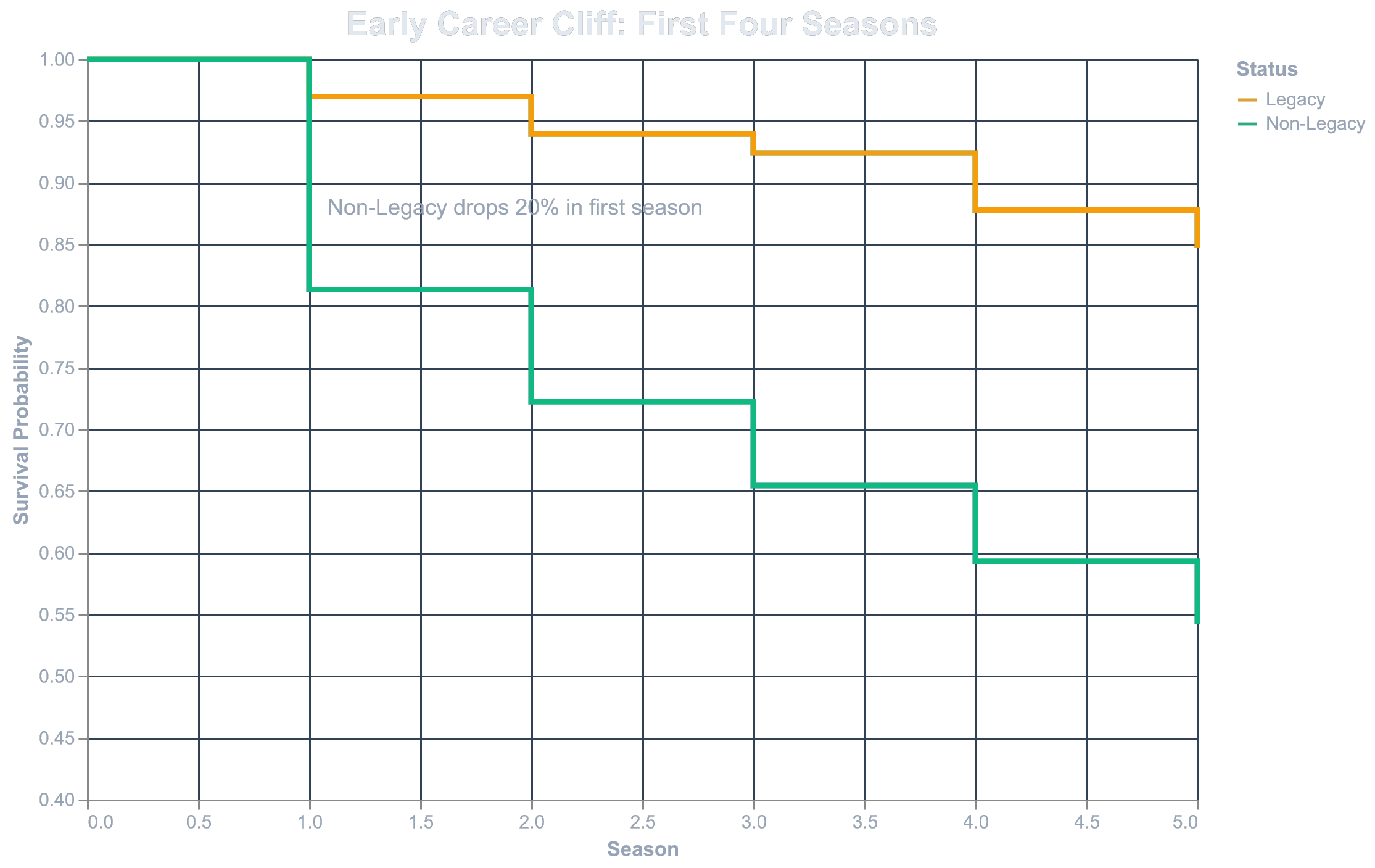
If you're a "Legacy Player" (your dad played in the NBA), your median career length is 13.0 seasons. But if you're a "Non-Legacy Player" (your dad was an accountant), your median career length is 5.0 seasons. Being a nepo baby is worth 8 additional years of employment. At the NBA median salary of roughly $4 million, that's a $32 million gift from the universe.
The brutal reality of the NBA is that most players are not LeBron James. Most players are replacement-level assets fighting to stay in the league. This is where the Legacy Premium shines.
If you're a Non-Legacy player, the attrition rate in the first four seasons is terrifying. You show up and don't instantly produce? You're gone. But, if you're a Legacy, that cliff is much gentler. You get the benefit of the doubt, or 1.5 extra years to "figure it out."
The Second Contract Arbitrage
The most important financial event in a player's career is not the draft. It's the second contract. The rookie scale is fixed. The second contract is when you get the bag.
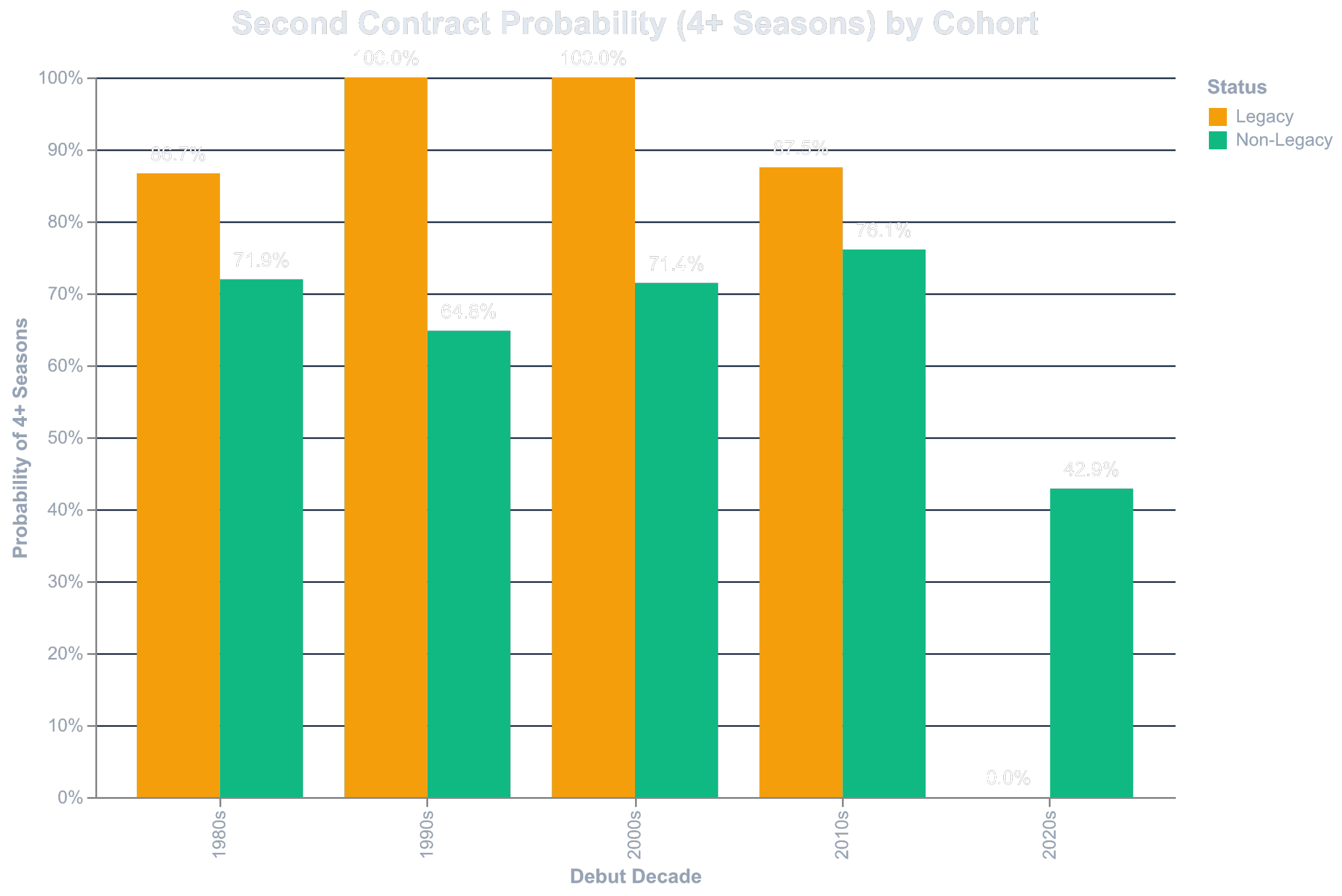
Through the 2000s, if you were a legacy player, you were virtually guaranteed a second contract. But that's starting to change. Maybe due to small sample sizes, or maybe due to the league finally valuing legacies a little less than before.
The Draft Pick Hedge
You might argue: "Wait, maybe the sons of NBA players are just... better? Maybe they're drafted higher because they're better, and they stay longer because they're better."
Fair point. Although, even when controlling for draft position, the pattern holds.
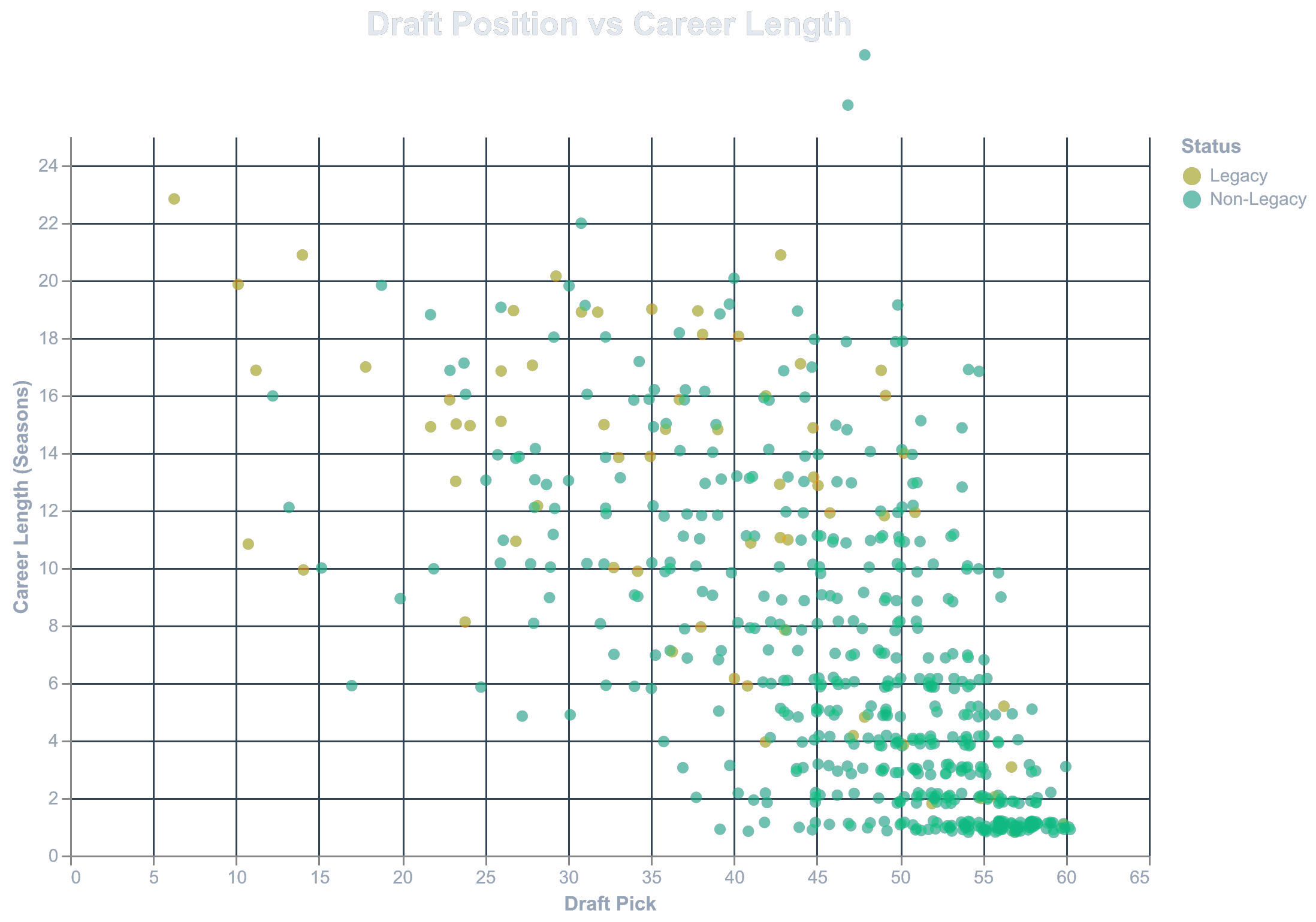
A 45th pick with a famous last name tends to stick around longer than a 45th pick without one. Non-Legacy players (green dots) cluster aggressively at the bottom: low pick, short career. Legacy players (amber dots) float pleasantly upward.
Things Happen
The point here is not that this is "unfair." NBA teams are private businesses and can hire whoever they want. If the Milwaukee Bucks want to employ Thanasis Antetokounmpo because it makes his older brother Giannis happy, that's a rational decision. It's just a "Keep Giannis Happy" tax.
But as a market phenomenon, I think it's fascinating. We tend to think of professional sports as the ultimate meritocracy, where the scoreboard doesn't lie. And mostly, it doesn't. But at the margins—at the end of the bench, in the G-League call-ups, in the training camp invites—the name on the back of the jersey matters more than we like to admit.